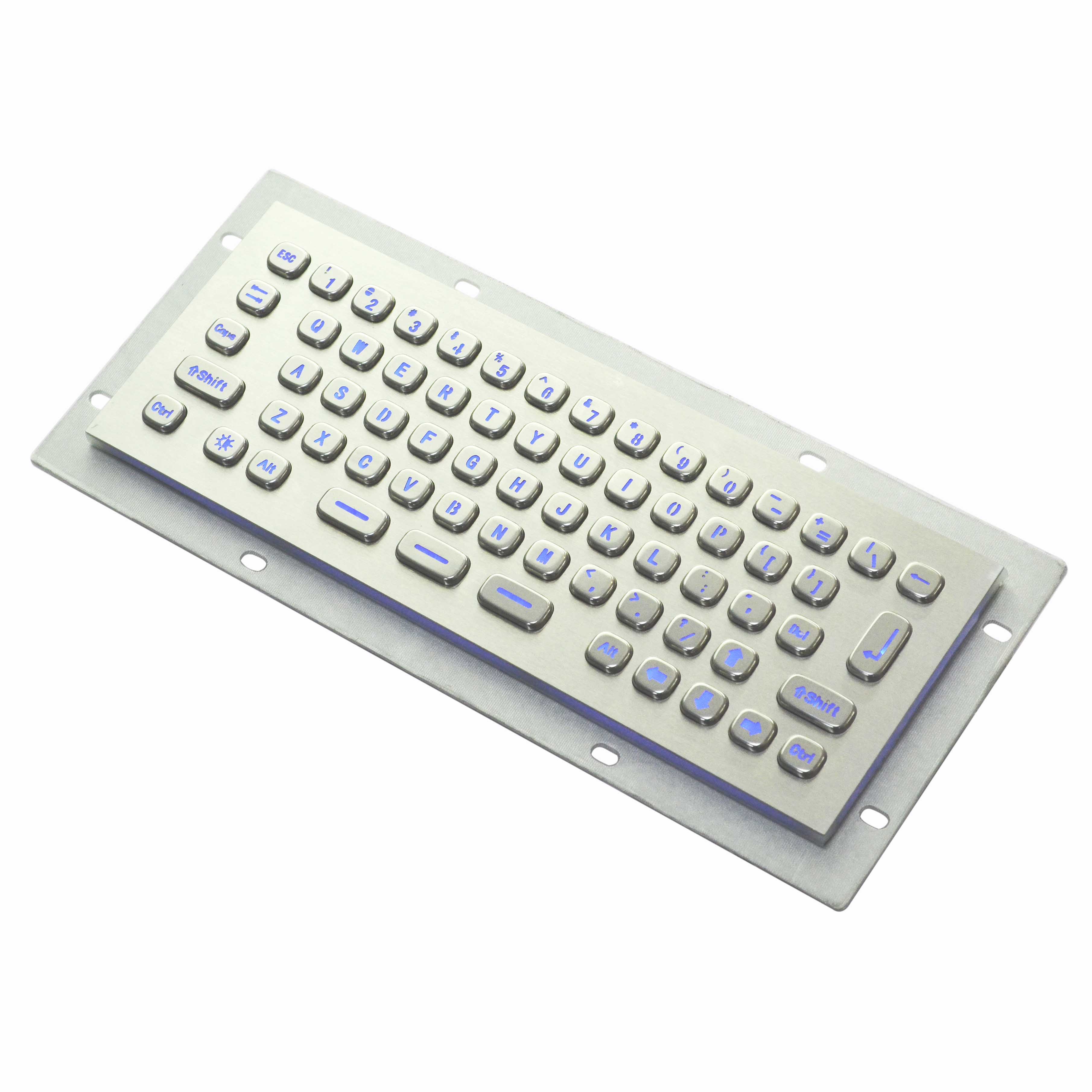
What are the practical designs of the anti-oil metal industrial keyboard?
author: Linsa
2026-01-06

In industrial, medical and self-service equipment scenarios, traditional keyboards often malfunction due to oil stains, dust or frequent operations. To address these needs, an industrial keyboard made of anti-oil metal material and integrating touchpad functionality has gradually become a preferred choice in professional fields. Its core design focuses on durability and functional compatibility. Through material and structural optimization, it meets the stable input requirements in complex environments.
I. Technical Principles and Structural Design:
This type of keyboard is made with 304 stainless steel as the main material for the keys. This material has the characteristics of corrosion resistance and wear resistance, capable of withstanding oil, water, and chemical substance erosion. The key sizes are divided into two specifications: 14×14×2.0mm and 20×14×2.0mm. By increasing the keycap area, the error touch rate is reduced, and at the same time, a scissors-heel or film-type triggering structure is adopted to ensure that it remains sensitive and responsive even after long-term use. The keyboard interior adopts a sealed design to prevent liquid from seeping into the circuit board, thereby extending its service life. Additionally, some models integrate a touchpad module, replacing the standalone mouse, reducing the desktop space occupation and enhancing the operational continuity.
II. Function Adaptation and Interface Expansion:
To meet the diverse requirements of industrial scenarios, the keyboard supports multiple interface types, including USB, PS2, RS232, and RS485, etc. Among them, the RS232 and RS485 interfaces can achieve long-distance data transmission, which is suitable for automated production lines or equipment control; the USB and PS2 interfaces are compatible with mainstream computer devices, reducing the adaptation cost. Functionally, the keyboard is equipped with 20 programmable shortcut keys, allowing users to customize functions according to their actual needs, such as One-click invocation of specific programs, switching of input modes, etc.. Some models also support backlighting, providing clear and visible key position identification in low-light environments.
III. Usage Scenarios and Customized Services:
This keyboard is mainly used in industrial control consoles, medical equipment operation panels, self-service terminals, etc. For instance, in food processing plants, operators need to wear gloves to adjust equipment parameters. The anti-slip texture and larger key spacing of the metal keys can enhance operational efficiency; in medical environments, the waterproof feature of the keyboard can prevent disinfectant from seeping in and causing damage. Additionally, the manufacturer offers interface customization services, including key position layout adjustments, logo printing, and interface protocol adaptation, to meet the specific needs of different industries. The customization period is usually 3 to 7 days, and it supports minimum order of one unit, reducing the threshold for small batch purchases.
IV. Technical Highlights and Practical Performance:
Compared to traditional keyboards, the metal industrial keyboard demonstrates outstanding durability and functionality. The 304 stainless steel material's corrosion resistance enables its lifespan to be more than three times that of ordinary keyboards; the sealed structure and dust-proof design reduce the maintenance frequency. In terms of function integration, the combination of the touchpad and shortcut keys simplifies the operation process, making it particularly suitable for scenarios where frequent switching between input methods is required. During actual testing, the keyboard can operate stably within a temperature range of -20°C to 60°C, demonstrating strong adaptability.
The core features of the medical stainless steel keyboard are centered around the three key requirements of hygiene, durability, and adaptability in medical settings.
Shenzhen Keyu officially launched its new silicone key metal keyboard.
Related Article

In industrial production, outdoor operations, and in environments that are humid and dusty, traditional keyboards often fail to withstand the test of the environment and are prone to malfunction. However, waterproof and dustproof industrial membrane keyboards, with their outstanding waterproof and dustproof capabilities, have become the preferred keyboards for these harsh environments.
Advantages of Industrial membrane keyboard