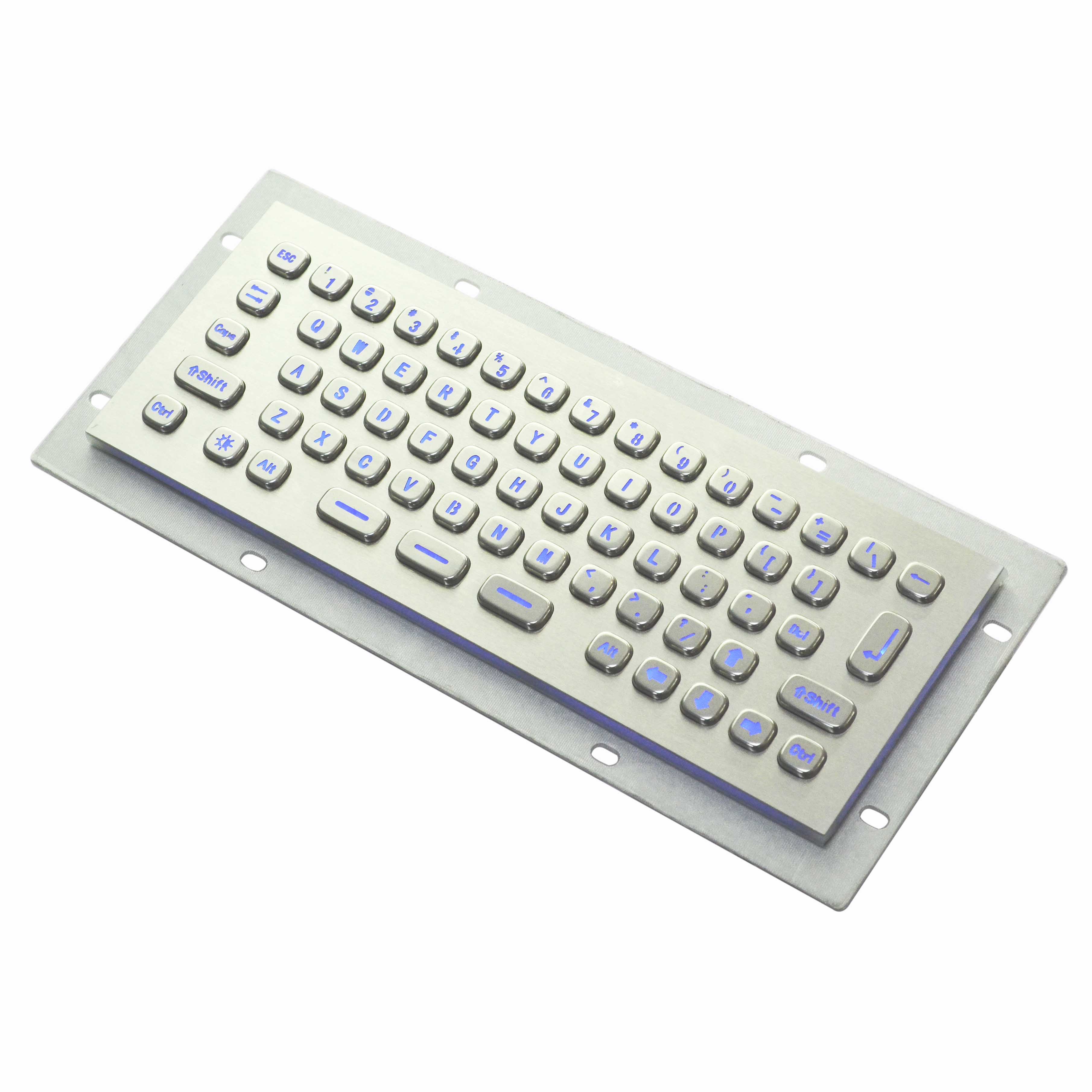
The Security Application and Protection Principles of Metal Keyboards on ATM Machines
author: Linsa
2025-07-03

Have you ever wondered why the password keypads on ATMs are always made of metal? There is actually a deep consideration behind this. Banks' ATMs usually come with metal number keypads, and this design is intended to ensure the security of users when they enter their passwords, thereby effectively preventing the leakage of password information.
The metal keyboard design of the ATM machine is a crucial physical security layer in the financial security system. It ensures the security of user passwords through multiple technical principles. The protection mechanism can be summarized into the following four aspects:
I. Thermal Imaging Resistance: Rapid Heat Dissipation
When fingers touch conventional keyboards, thermal traces remain on key surfaces (temperature difference up to 5°C), allowing criminals to decipher password sequences via thermal cameras12. Metal keyboards utilize ultra-high thermal conductivity (copper/nickel-chromium alloys >400W/m·K), reducing temperature differences to <0.5°C within 3 seconds—rendering thermal imaging ineffective34. For instance, stainless steel keys restore ambient temperature in 10 seconds, outperforming plastic's 2-minute residual period5.
II. Physical Protection: Anti-Tampering & Anti-Observation
- Vandalism Resistance
Made of 304 stainless steel (thickness ≥1.5mm), the keyboard withstands 50J impacts (20x stronger than plastic). Pressure sensors trigger auto-lock and alarms upon detecting abnormal force (>500g sustained pressure) - Anti-Peeping & Anti-Fraud
Random textured keys (depth 0.2mm±0.05mm) disrupt fake keypad overlays. Combined with reflective properties and ATM cabin isolation (5mm glass + 0.1mm anti-spy film), it prevents lateral visual theft.
III. Electronic Security: Encryption & Anti-Eavesdropping
- Hardware Encryption
Embedded chips support SM2/SM4/DES/TDES/AES algorithms, encrypting PINs upon keystroke. Intercepted ciphertext requires dedicated decryption hardware. - EMI Shielding
The metal casing acts as a Faraday cage, blocking >80dB electromagnetic signals. Capacitive sensing detects non-conductive overlays (e.g., fake keypads) and triggers alarms upon abnormal current.
IV. Compliance: Financial Security Certifications
Metal keyboards must meet:
- Physical Security: PCI-PTS 5.0 anti-tampering (self-destructs upon unauthorized access);
- Environmental: IP65 rating (dust/waterproof), operable at -40℃~60℃67;
- Regulatory: Complies with Commercial Bank IT Risk Management Guidelines and JR/T 0259-2023 standards.
The features of military keyboards
What are the differences between industrial mouse and traditional mouse?
Related Article

In industrial production, outdoor operations, and in environments that are humid and dusty, traditional keyboards often fail to withstand the test of the environment and are prone to malfunction. However, waterproof and dustproof industrial membrane keyboards, with their outstanding waterproof and dustproof capabilities, have become the preferred keyboards for these harsh environments.
Advantages of Industrial membrane keyboard